
Moving beyond generic messages to create deep, meaningful connections that drive growth.
Key Insights into Digital Personalization
- Personalization is a Necessity: In today’s crowded digital landscape, personalization is no longer a luxury but an indispensable strategy for businesses to cut through noise and connect effectively with customers.
- Synergy with Targeted Marketing: Effective personalization is built upon robust targeted marketing, where audience segmentation informs highly relevant, individualized content and offers, leading to higher ROI and better lead quality.
- Engagement and Conversions: By tailoring content and experiences, personalized marketing significantly enhances customer engagement, fostering loyalty and directly contributing to increased conversion rates and customer lifetime value.
Where consumers are barraged with an unending stream of information, the ability to stand out and forge genuine connections has become paramount. This critical need has elevated personalization in digital marketing from a nascent trend to a foundational strategy. It transcends the basic act of addressing a customer by their name; instead, it involves a sophisticated orchestration of data, advanced analytics, and cutting-edge technologies like artificial intelligence (AI) to deliver highly relevant and tailored experiences that resonate deeply with individual preferences, behaviors, and needs.
This comprehensive approach not only elevates the customer experience but also profoundly impacts business outcomes, leading to increased conversion rates, enhanced brand loyalty, and superior customer retention. As of today, June 11, 2025, personalization is the cornerstone for brands aiming to thrive in a fiercely competitive digital environment.
Decoding Personalization in Digital Marketing
At its core, personalization is the strategic adaptation of marketing content, offers, and experiences to individual customers based on their unique data, preferences, and past interactions. This “one-to-one” approach, sometimes referred to as individual marketing, leverages big data, advanced analytics, and AI to craft bespoke experiences. The overarching goal is to deliver the optimal message to the right person at the precise moment, cultivating a profound sense of individual attention and care. While early forms of personalization were relatively simple, such as using a customer’s first name in an email, the strategy has evolved dramatically to incorporate sophisticated methods that predict future behaviors and offer highly tailored recommendations across a multitude of digital channels.
The Evolution of Personalization: From Basic to Behavioral
The journey of personalization has seen a remarkable evolution. Initially, it was about surface-level customization. Today, it delves into predictive analytics, utilizing vast datasets to anticipate what a customer might want or need next. This shift from reactive to proactive personalization is driven by the sheer volume of data available and the technological capacity to process it. Businesses can now track browsing history, purchase patterns, geographic location, and even real-time engagement to create truly dynamic and responsive experiences.
The Indispensable Role of Targeted Marketing
Personalization is inextricably linked with targeted marketing, which focuses on identifying and actively engaging with specific segments of an audience. For personalization to be effective, businesses must first define their audience through meticulous segmentation. This process involves using data to divide the overall audience into smaller, more homogeneous groups based on shared characteristics. This foundational step enables the creation of messaging and campaigns that are highly relevant to each segment’s unique desires, wants, and challenges.
Strategic Advantages of Targeted Marketing
The benefits derived from a well-executed targeted marketing approach are extensive:
- Higher Return on Investment (ROI): By concentrating marketing efforts on the most promising prospects, businesses can achieve superior results with minimized wasted resources, directly translating to a higher ROI. This efficiency ensures that every marketing dollar is spent where it is most likely to yield conversions.
- Enhanced Content Value: Targeted marketing facilitates the creation of high-quality content that directly addresses the specific needs and interests of a defined audience, rather than generic materials that may appeal to no one in particular. This increases the perceived value of the content.
- Improved Customer Connection: This specialized approach fosters a deeper, more meaningful connection with customers by demonstrating a clear understanding of their individual needs and preferences, leading to stronger relationships.
- Increased Efficiency and Effectiveness: It dramatically boosts the overall efficiency and effectiveness of marketing efforts by concentrating resources on segments where they are most likely to generate results, optimizing campaign performance.
- Better Lead Quality: By connecting directly with a specific, pre-qualified audience, targeted marketing attracts high-quality leads who are more likely to convert into loyal customers.
- Brand Differentiation: A targeted approach helps a brand distinguish itself in a saturated market by offering uniquely relevant experiences that competitors might overlook, thereby strengthening brand identity and appeal.

Visual representation of how personalized communication influences digital marketing campaigns.
Elevating Customer Engagement Through Personalization
Customer engagement refers to the ongoing interactions and activities meticulously organized to create an ultimate customer experience. Personalization acts as a powerful catalyst for enhancing customer engagement, which, in turn, leads to increased loyalty and sales. When marketing content and offers are precisely tailored to individual customers, they are significantly more likely to capture interest and encourage active interaction.
Key Strategies for Personalized Customer Engagement
- Personalized Product Suggestions: Drawing inspiration from giants like Amazon and Netflix, businesses can track browsing history and past purchases to suggest products, movies, or shows that genuinely align with individual preferences, dramatically increasing the likelihood of conversion.
- Targeted Email Campaigns: Emails featuring personalized subject lines boast significantly higher open rates. Beyond just using a customer’s first name, emails can be customized based on wishlists, past purchases, or browsing behavior to re-engage users and drive sales effectively.
- Customer-Focused Social Media Campaigns: Leveraging social media platforms to deliver tailored content and offers based on user data can cultivate more engaging and meaningful interactions, fostering a sense of community.
- Personalized Website Experiences: Dynamic websites powered by AI can adapt their content and offers in real-time based on a visitor’s behavior and preferences. For instance, exit-intent pop-ups can be personalized to re-engage users contemplating leaving the site, offering a relevant incentive.
- Omnichannel Personalization: Ensuring a consistent and cohesive customer journey across all touchpoints – including online platforms, in-store interactions, mobile applications, and SMS – by integrating digital tools and leveraging customer data across channels. This holistic approach creates a seamless brand experience.
- Free Trial Offers and Coupons: Tailoring offers for free trials or discounts based on a user’s demonstrated interest or past interactions can effectively encourage conversion by providing a perceived benefit.
Driving Conversions with Personalized Strategies
The ultimate objective of personalization in digital marketing is to drive conversions and generate substantial revenue. By delivering highly relevant messages and offers, businesses can significantly improve their conversion rates, guiding customers more effectively through the sales funnel.
Tactics Demonstrating Personalization’s Conversion Power
- Automated Marketing: Marketing automation tools enable customized messages to be sent at optimal times based on individual consumer behaviors and triggers, ensuring timely and highly relevant communication that prompts action.
- AI-Driven Optimization: AI and machine learning process vast amounts of data to predict trends, forecast responses to marketing efforts, and automate personalized experiences. This leads to more efficient campaigns and higher conversion rates. Generative AI, for example, can create and scale highly relevant messages with bespoke tone, imagery, and copy at remarkable volume and speed.
- Data-Driven Decision Making: Personalization heavily relies on organizing, maintaining, and storing clean, focused customer data. This meticulously curated data then informs marketing strategies, identifies new opportunities, and facilitates the delivery of highly targeted messages. Customer Relationship Management (CRM) systems are indispensable for centralizing customer data and providing a unified view of the customer journey, enabling more informed strategic decisions.
- Respecting Privacy: While personalization is incredibly powerful, it is crucial to balance its implementation with customer privacy concerns. Brands must be transparent about data collection and usage, offering clear opt-in/opt-out options and rigorously complying with data privacy regulations like GDPR and CCPA to build and maintain trust. Over-personalization can be perceived as invasive and lead to customers disengaging or even blocking the brand.
Key Performance Indicators (KPIs) in Personalized Marketing
To measure the effectiveness of personalization efforts, it’s essential to track specific KPIs that reflect both engagement and conversion success. The following charts illustrate the impact of personalized marketing across various performance metrics, based on typical improvements seen in the industry.
Personalization Impact on Engagement Metrics
This radar chart provides an opinionated analysis of how personalization impacts various customer engagement metrics on a scale of 0 to 5, with 5 being the highest impact. This illustrates the multifaceted benefits of a personalized approach in fostering deeper connections with customers.

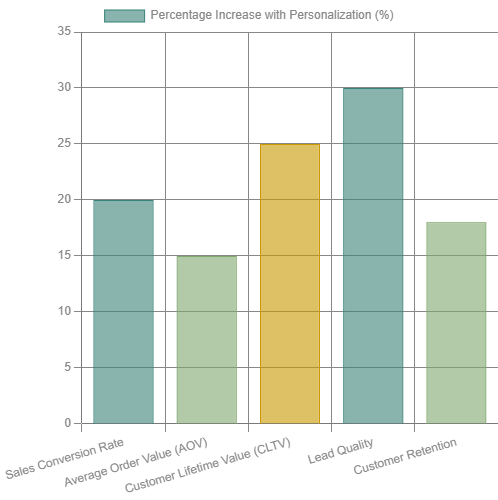
Personalization’s Influence on Conversion Metrics
This bar chart illustrates the estimated percentage increase in key conversion metrics when personalization strategies are effectively implemented, showcasing typical gains experienced by businesses.
Strategic Implementation of Personalization
Implementing effective personalization requires a structured approach, integrating data collection, segmentation, content tailoring, and an omnichannel strategy.
Core Implementation Steps
- Data Collection & Analysis: Gather comprehensive customer data through surveys, forms, website analytics, CRM systems, and social media interactions to understand preferences and behaviors. This data forms the bedrock of all personalized efforts.
- Audience Segmentation: Divide the audience into meaningful segments based on demographics, interests, purchase history, and behavioral patterns. This allows for tailored messages that resonate with specific groups before individualization.
- Content Personalization: Utilize AI and marketing automation tools to dynamically personalize content across all platforms. This ensures that messages, product recommendations, and offers are highly relevant and engaging for each individual.
- Omnichannel Approach: Implement an integrated omnichannel strategy to ensure consistent and coherent customer engagement across every touchpoint, from email and social media to website interactions and mobile apps.
Essential Technologies and Tools
- AI and Machine Learning: Leverage AI to analyze vast customer datasets, predict future behaviors, and enable real-time personalization at scale. Generative AI is particularly impactful for creating bespoke content.
- Marketing Automation Platforms: Use automation tools to streamline the entire personalization process, ensuring timely and consistent interactions across the customer journey without manual intervention.
- Customer Relationship Management (CRM) Systems: Utilize CRM systems as the central hub for storing, managing, and synthesizing customer data. CRMs provide a unified view of the customer, facilitating highly targeted marketing efforts and improved customer service.
The Transformative Power of Targeted Marketing in Action
To truly grasp the significance of personalization, it’s beneficial to understand its foundational element: targeted marketing. The following video delves into what targeted marketing entails, and how it lays the groundwork for personalized digital strategies. It emphasizes tailoring promotional efforts to reach specific and predefined audience segments, which is exactly where personalization begins to shine by refining this segmentation to an individual level.
“What is targeted marketing?” – An insightful video explaining the core concepts.
Comparative Overview of Personalization Strategies
Different personalization strategies yield varying degrees of effectiveness across different marketing objectives. This table summarizes common personalization tactics, their primary objectives, and typical outcomes.
| Personalization Tactic | Primary Objective | Typical Outcome | Key Technologies Involved |
|---|---|---|---|
| Personalized Product Recommendations | Increase Average Order Value (AOV), Drive Repeat Purchases | Higher conversion rates, increased basket size | AI, Machine Learning, E-commerce Platforms |
| Targeted Email Campaigns | Boost Open Rates, Drive Click-Throughs, Re-engagement | Improved lead nurturing, reduced cart abandonment | Marketing Automation, CRM, AI |
| Dynamic Website Content | Enhance User Experience, Guide Customer Journey | Lower bounce rates, increased time on site | Content Management Systems (CMS), AI, A/B Testing tools |
| Behavioral Triggers (e.g., Abandoned Cart) | Recover Lost Sales, Nurture Leads | Higher conversion of stalled interactions | Marketing Automation, CRM |
| Personalized Social Media Ads | Increase Engagement, Drive Traffic to Offers | Higher ad relevance, improved ROAS (Return on Ad Spend) | Social Media Ad Platforms, Audience Data Platforms |
| Personalized Service & Support | Enhance Customer Satisfaction, Build Loyalty | Reduced churn, positive word-of-mouth | CRM, Chatbots, Customer Service Software |
Challenges and Future Directions
While the benefits of personalization are compelling, its implementation is not without challenges. Foremost among these are navigating data privacy concerns and ensuring compliance with evolving regulations like GDPR and CCPA. The sheer volume and complexity of customer data necessitate sophisticated technology and skilled personnel for effective management and extraction of actionable insights. Moreover, there’s a fine line between helpful personalization and intrusive “over-personalization” that can alienate customers. Brands must constantly balance relevance with respect for customer boundaries.
As we advance through 2025, the future of personalization is poised to be shaped by further innovations in AI and generative AI, enabling the creation of content and messaging at unprecedented speed and scale. The integration across digital and physical channels will become more seamless, allowing brands to craft a fully cohesive personalized customer journey. However, the human element—deep empathy and understanding of customer needs—will remain at the heart of successful personalization. In a world saturated with generic advertising, personalization offers a powerful way for brands to cut through the noise, build authentic relationships, and drive sustainable business growth.
Conclusion
In summary, personalization in digital marketing represents a pivotal evolution in how businesses engage with their audiences. By seamlessly integrating data-driven strategies with foundational principles of targeted marketing and robust customer engagement tactics, companies can cultivate profound connections that not only foster unwavering loyalty but also significantly accelerate conversions. As the digital landscape continues its rapid advancement, the capacity to deliver meticulously tailored experiences will serve as a critical differentiator for brands striving to maintain a competitive edge. Embracing personalization fundamentally improves immediate outcomes, such as sales and lead quality, but more importantly, it lays a resilient foundation for sustained growth in an increasingly individualized digital world. To fully capitalize on these immense opportunities, businesses must relentlessly prioritize ethical data utilization and continuous innovation, ensuring that personalization remains a powerful instrument for authentic value creation for both the brand and its cherished customers.
Frequently Asked Questions (FAQ)
What is personalization in digital marketing?
Personalization in digital marketing is the strategic approach of tailoring marketing content, offers, and experiences to individual customers based on their unique data, preferences, and past interactions, moving beyond generic messaging to create bespoke experiences.
How does personalization enhance customer engagement?
Personalization enhances customer engagement by delivering highly relevant, timely content and offers, creating interactive experiences, ensuring omnichannel consistency, and building trust through transparent data usage. This makes customers feel understood and valued, encouraging deeper interaction.
What is the relationship between personalization and targeted marketing?
Targeted marketing is a foundational component of personalization. It involves segmenting an audience into smaller groups based on shared characteristics. Personalization then takes this a step further by customizing experiences for individual customers within those segments, making campaigns even more precise and effective.
How does personalized marketing drive conversions?
Personalized marketing drives conversions by delivering tailored messages and offers that are highly relevant to an individual’s needs and preferences. This reduces friction in the buying process, prompts specific actions (like purchases or sign-ups), and leverages behavioral triggers to recover lost sales opportunities, leading to higher conversion rates and average order values.
What technologies are crucial for implementing personalization?
Key technologies for implementing personalization include Artificial Intelligence (AI) and Machine Learning for data analysis and predictive insights, Marketing Automation platforms for streamlining campaigns, and Customer Relationship Management (CRM) systems for centralized customer data management.
Discover more from Web Pivots®
Subscribe to get the latest posts sent to your email.


You must be logged in to post a comment.