


Most keyword research tutorials stop at “open Google Keyword Planner and look for high-volume terms.” That advice isn’t wrong — it’s just the first step of a ten-step process presented as the whole thing. The businesses that rank consistently aren’t just finding keywords; they’re running a structured workflow that connects keyword research services to content strategy, page architecture, and actual search intent. This guide teaches that full workflow — not just how to find keywords, but how to evaluate, cluster, and deploy them so every piece of content you publish has a real shot at ranking.
Whether you’re doing this yourself for the first time or trying to systematize a process that’s been improvised until now, the method here gives you a repeatable sequence you can run on any topic in any niche.
Why Keyword Research Strategy Determines Content Success?
Keyword research isn’t just a traffic exercise. It’s the foundation of a content strategy that actually aligns with what real people are actively searching for. Publishing without it is the equivalent of opening a store in a location nobody passes — the product might be excellent, but the traffic won’t come because nobody knows to look there. Done properly, keyword research tells you not just what people are searching, but why they’re searching it and what kind of content they expect to find when they do.
What Happens Without a Keyword Strategy?
Without a defined keyword strategy, content tends to get created based on what the team finds interesting or what a competitor published last week — neither of which reliably maps to actual search demand. The result is a content library full of posts with no organic traffic, competing internally against each other for the same vague terms, and no clear architecture connecting related topics into a coherent site structure.
Step One: Start With Seed Keywords?
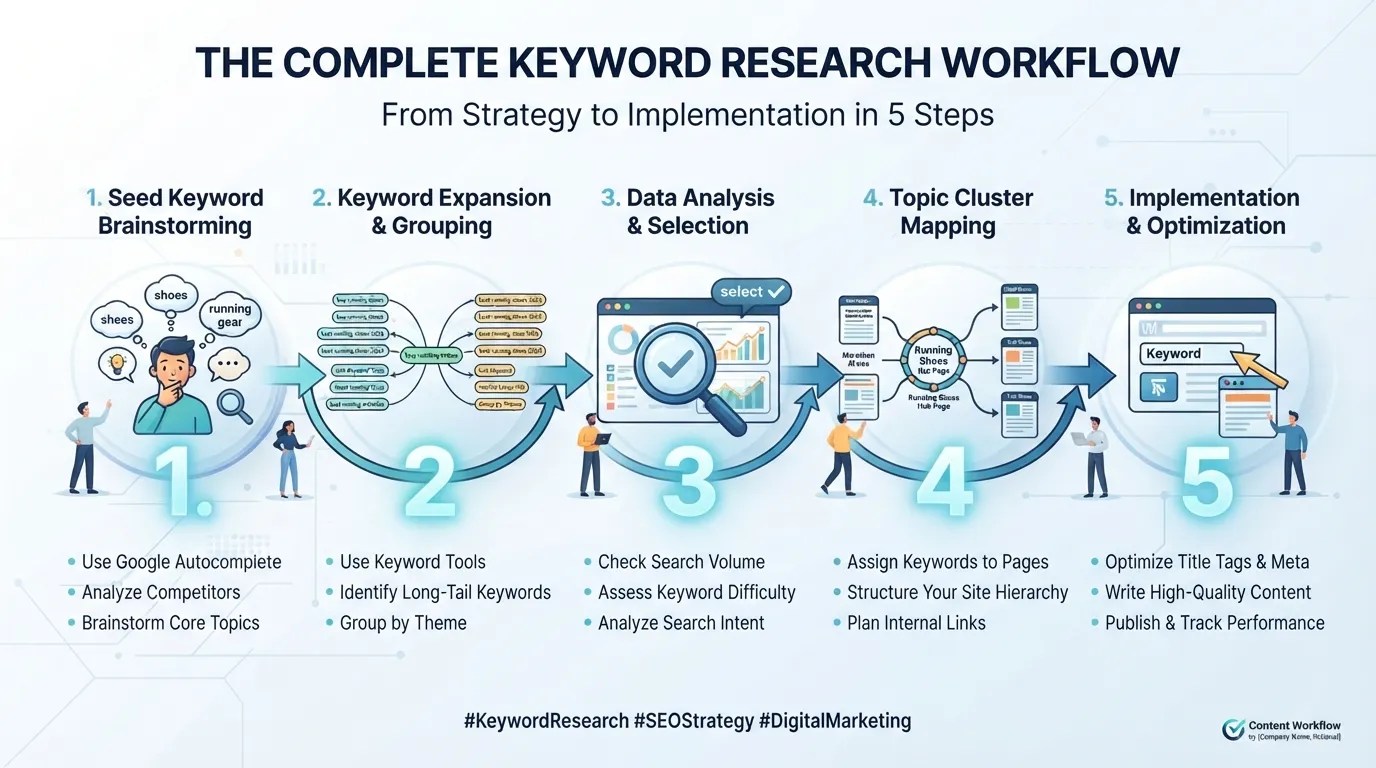
Every keyword research workflow starts in the same place: a short list of seed keywords — broad, foundational terms that describe your core topics, services, or products. These aren’t the keywords you’ll necessarily target directly; they’re the starting point you expand from.
How to Identify the Right Seed Keywords?
Think about how your customers describe their problems, not how your industry describes your solutions. A law firm might internally call their service “estate planning,” but their clients might search “what happens to my assets when I die” or “how to avoid probate.” Both are seeds — but the second set points toward the language real searchers actually use. Start with three to five broad seeds per core topic area, then let the tools do the expansion.
Step Two: Expand With Keyword Research Tools
Once you have seed keywords, the next step is expanding them into a full keyword universe using seo tools built for exactly this purpose. You don’t need a premium suite to do this effectively — the free tool stack covers most of what a small to mid-size business needs.
Google Search Console
If your site has any existing traffic, Google Search Console is the single most underused keyword research tool available — and it’s free. The Performance report shows every query real users have typed and clicked through to your site, including terms you might not have considered targeting explicitly. These are high-intent, already-validated keywords from your actual audience, not modeled estimates from a third-party database.
Ubersuggest
Ubersuggest generates keyword expansions from a seed term, shows estimated search volume, and provides a keyword difficulty score indicating how competitive a term is to rank for. At the free tier it’s limited in daily queries, but for methodical research it’s more than sufficient to build a solid initial keyword list without any subscription cost.
AnswerThePublic
AnswerThePublic maps the questions, prepositions, and comparisons people build around a seed keyword — structured as visualizations showing exactly what your audience is asking Google. It’s particularly valuable for finding informational keyword variations that signal content topics, FAQ opportunities, and the specific language real users reach for when describing their problem.
Step Three: Filter by Intent and Difficulty
A raw keyword list from expansion tools is too large and too undifferentiated to work from directly. The next step — filtering by keyword intent and difficulty — is what separates a useful keyword strategy from an overwhelming spreadsheet.
The Three Types of Keyword Intent
Informational intent describes searches where the user wants to learn something: “how does SEO work,” “what is a conversion rate,” “why is my website slow.” These keywords drive traffic and build authority but rarely convert directly — they’re top-of-funnel assets.
Commercial intent sits in the middle: the user is evaluating options and moving toward a decision. “Best keyword research tools,” “keyword research services vs doing it yourself,” “Ubersuggest vs Ahrefs” — these users are researching before buying. Content targeting commercial intent tends to convert better than purely informational content.
Navigational intent means the user is looking for a specific brand or page. These are rarely worth targeting unless they’re your own brand terms, since users with navigational intent have already made their decision.
Filtering by Keyword Difficulty
Keyword difficulty scores estimate how competitive a term is based on the authority of pages currently ranking for it. A new or low-authority domain targeting a keyword with a difficulty score of 80 out of 100 is competing against established players with years of link equity — an uphill battle with a slow return. Prioritizing keywords your domain can realistically rank for given its current authority produces faster wins and builds momentum for targeting harder terms later. Long tail keywords — more specific, lower-volume phrases — almost always carry lower difficulty scores and higher conversion rates than broad, high-volume terms.
Step Four: Cluster Keywords Into Topic Groups
Individual keywords don’t exist in isolation — they cluster naturally into topic groups that reflect how search engines understand related content. Building a topic cluster structure around these groups is both an SEO strategy and a content architecture decision.
How Topic Clusters Work?
A topic cluster consists of one comprehensive pillar page targeting a broad keyword, supported by multiple cluster pages targeting related, more specific keywords — all interlinked. The pillar page covers the topic broadly; each cluster page goes deeper on a specific subtopic. This structure signals topical authority to search engines: a site with a pillar page on “keyword research” and ten cluster pages on subtopics like “keyword intent,” “long tail keywords,” and “keyword gap analysis” looks far more authoritative on that topic than a site with one isolated post and nothing else surrounding it.
Identifying Keyword Gaps
A keyword gap analysis compares your current keyword coverage against competitors ranking in the same space — revealing terms your competitors rank for that you don’t. These gaps represent both missed traffic and a clear content roadmap: topics the market has validated as worth ranking for that your site hasn’t yet addressed.
Step Five: Map Keywords to Pages
Once keywords are clustered, each cluster needs to be mapped to a specific page on the site — either an existing page that can be optimized or a new page to be created. This mapping step is what converts a keyword list into a content plan.
Avoiding Keyword Cannibalization
Keyword cannibalization happens when multiple pages on the same site target the same or closely overlapping keywords, essentially competing against each other in search results. The mapping step prevents this by ensuring each keyword has one designated page owner — making the site’s content architecture clear to both users and search engines.
How Keyword Research Feeds Content Strategy?
A completed keyword map is, functionally, a content calendar. Every unmapped keyword represents a content gap — a page that needs to be created. Every mapped keyword on an existing page represents an optimization opportunity — content that should be reviewed and strengthened to better match the search intent behind that term. This is how keyword research services feed directly into content production priorities rather than existing as a separate exercise disconnected from what gets published.
Running a SERP Analysis Before Finalizing
Before committing to a keyword, it’s worth running a SERP analysis — actually looking at the search results page for that term to understand what Google currently thinks satisfies the intent. If the top ten results are all product pages and yours is going to be a blog post, that’s a mismatch worth knowing before investing in the content. If the SERP is dominated by listicles and your planned content is a deep guide, that’s equally worth understanding — and potentially an opportunity to differentiate.
Reading SERP Features as Intent Signals
The features Google surfaces in a SERP — featured snippets, People Also Ask boxes, local packs, image carousels — are signals of intent. A SERP showing a featured snippet for a definition-style query tells you Google wants a concise, direct answer at the top of the page. A local pack tells you the intent is location-specific. Reading these signals shapes how the content targeting that keyword should be structured, not just what it should cover.
Common Keyword Research Mistakes Worth Avoiding
Even with the right tools and workflow in place, a few recurring mistakes tend to undermine keyword strategies that looked solid on paper.
Chasing Search Volume Over Intent
A keyword with 50,000 monthly searches sounds far more attractive than one with 500 — until you examine what kind of content ranks for it and realize there’s no realistic path to that page one for your domain. Search volume is a useful signal, but it should always be weighed against difficulty and intent fit. A tightly targeted keyword with 500 monthly searches and clear commercial intent will consistently outperform a high-volume informational term on actual business impact.
Ignoring What’s Already Ranking
Skipping the SERP analysis step means publishing content without knowing what Google currently thinks the right answer looks like. If the top results for your target keyword are all video tutorials and yours is a long-form text guide, the mismatch between your content format and the established search intent will limit how far that page can climb — regardless of how well-written it is.
Targeting Every Keyword on a Single Page
Trying to target ten related keywords on one page in the hope that it ranks for all of them usually results in ranking well for none of them. Search engines reward pages that clearly and comprehensively answer one specific intent, not pages that attempt to be all things simultaneously. The topic cluster model exists precisely to solve this — giving each keyword its own dedicated page rather than diluting all of them into one.
Putting the Full Workflow Together
The sequence — seed keywords, tool-based expansion, intent and difficulty filtering, topic clustering, page mapping, and SERP analysis — is repeatable for any topic, any niche, and any stage of site maturity. Run it properly once, and you have a content roadmap grounded in actual search demand rather than guesswork. Run it quarterly as a review cycle, and you have a living strategy that adapts as your domain authority grows and new keyword opportunities emerge.
The businesses consistently generating organic traffic aren’t publishing more than their competitors. They’re publishing more strategically — every piece of content tied to a real keyword, a real intent, and a real gap in the existing SERP landscape.
Want a professional keyword strategy built for your specific site and competitive landscape? Talk to our keyword research team and get a roadmap your content production can actually follow.
Frequently Asked Questions
Start with seed keywords describing your core topics, expand them using tools like Google Search Console, Ubersuggest, and AnswerThePublic, filter by intent and difficulty, cluster related terms into topic groups, and map each cluster to a specific page on your site.
Focus on long tail keywords with lower difficulty scores and clear commercial or informational intent before targeting broad, high-competition terms. Use free tools to build your initial list and prioritize terms your domain can realistically rank for at its current authority level.
Long tail keywords are more specific, lower-volume search phrases — “keyword research strategy for small business” rather than just “keyword research.” They carry lower difficulty scores, higher conversion rates, and are far easier for newer or lower-authority domains to rank for.
A keyword gap analysis compares the terms your competitors rank for against your own current keyword coverage, revealing topics with validated search demand that your site hasn’t addressed yet.
A full keyword research cycle every three to six months keeps your strategy current as search behavior shifts and your domain authority grows — allowing you to target progressively more competitive terms as your site matures.
Discover more from Web Pivots®
Subscribe to get the latest posts sent to your email.
You must be logged in to post a comment.