


If you’ve ever tried applying a B2C SEO playbook to a B2B business and wondered why the results don’t translate, the reason is structural. B2B SEO operates on fundamentally different rules — not because the search engine works differently, but because the buyer does. B2C purchases are often emotional, fast, and made by a single person. B2B purchases are rational, slow, and made by committees. The search behavior that precedes a B2B purchase reflects that reality: lower volume, higher specificity, longer time horizons, and a content appetite that spans months rather than days. A b2b seo agency that understands this builds strategy around the B2B buyer’s actual journey — not a simplified version borrowed from consumer marketing.
This guide covers the full B2B SEO picture: how keyword research differs, what content looks like at each stage of a long sales cycle, how thought leadership compounds over time, where technical SEO creates specific advantages in B2B, and how organic traffic converts to pipeline rather than just sessions.
Why B2B SEO Is Fundamentally Different from B2C?
The surface-level mechanics of SEO are the same regardless of who you’re selling to — keywords, content, backlinks, technical health. What changes is the strategy layered on top of those mechanics, because the buyer’s behavior is so different.
The Long Sales Cycle Changes Everything
A B2C buyer might search, click, read, and purchase within hours. A B2B buyer researching an enterprise software solution might spend weeks or months consuming content, comparing vendors, building an internal business case, and getting sign-off from procurement before a purchase order is even discussed. The long sales cycle means B2B SEO content needs to serve buyers across a much wider temporal range than B2C content — a piece that helps someone understand their problem in January might be the same piece that resurfaces in their research in April when they’re finally ready to evaluate vendors.
Multiple Stakeholders, Multiple Search Journeys
B2B purchases typically involve multiple decision makers — a technical evaluator, an end user, a budget holder, and a procurement gatekeeper might all be involved in a single purchase decision. Each of those stakeholders searches differently, reads different content, and needs different information to move forward. A B2B content strategy that only speaks to one of those personas is leaving the others unserved, which means the deal can stall at the stakeholder your content doesn’t reach.
Lower Volume, Higher Intent
B2B keywords almost always carry lower search volumes than their B2C equivalents — and that’s a feature, not a problem. A keyword like “enterprise data warehouse migration consultant” might get 200 searches a month, but every one of those searches represents a qualified buyer with real budget and real urgency. One converted visitor from that keyword is worth orders of magnitude more than a thousand consumer searches. B2B SEO strategy should be built around this reality: stop chasing volume and start chasing intent.
B2B Keyword Research: Finding Decision Maker Keywords
Standard keyword research tools are built primarily around consumer search behavior, which means their volume estimates for B2B terms are often unreliable and their suggestions frequently miss the specific language B2B buyers use. Effective b2b keyword research requires a different sourcing approach.
Research Pain Points, Not Products
B2B buyers rarely start their search by naming your solution category. They start by searching their problem: “why is our sales team’s close rate declining,” “how to reduce customer churn in SaaS,” “what’s causing our supply chain delays.” Decision maker keywords are pain-first, not solution-first. The businesses that rank for the problem search own the top of the funnel before competitors who only rank for solution searches even enter the picture.
Job Title and Role-Specific Keywords
B2B searches frequently include role context — “seo strategy for marketing directors,” “data security for CFOs,” “HR software for distributed teams.” These modifiers signal the stakeholder behind the search, which makes them valuable not just for ranking but for serving the right content to the right person at the right time. Building content clusters around each key stakeholder persona — and the specific searches that persona runs at each stage of their research — is one of the most underused tactics in b2b content marketing.
Intent Data as a Keyword Research Layer
Intent data — signals that indicate a company is actively researching a topic or category — has become a meaningful complement to traditional keyword research for B2B strategies. When intent data shows that companies in your target segment are consuming content about a specific problem, that’s a signal worth building content around, even when the associated search volume looks modest on paper. Intent data and keyword research together produce a more complete picture of B2B buyer behavior than either does alone.
Content Strategy for the B2B Funnel
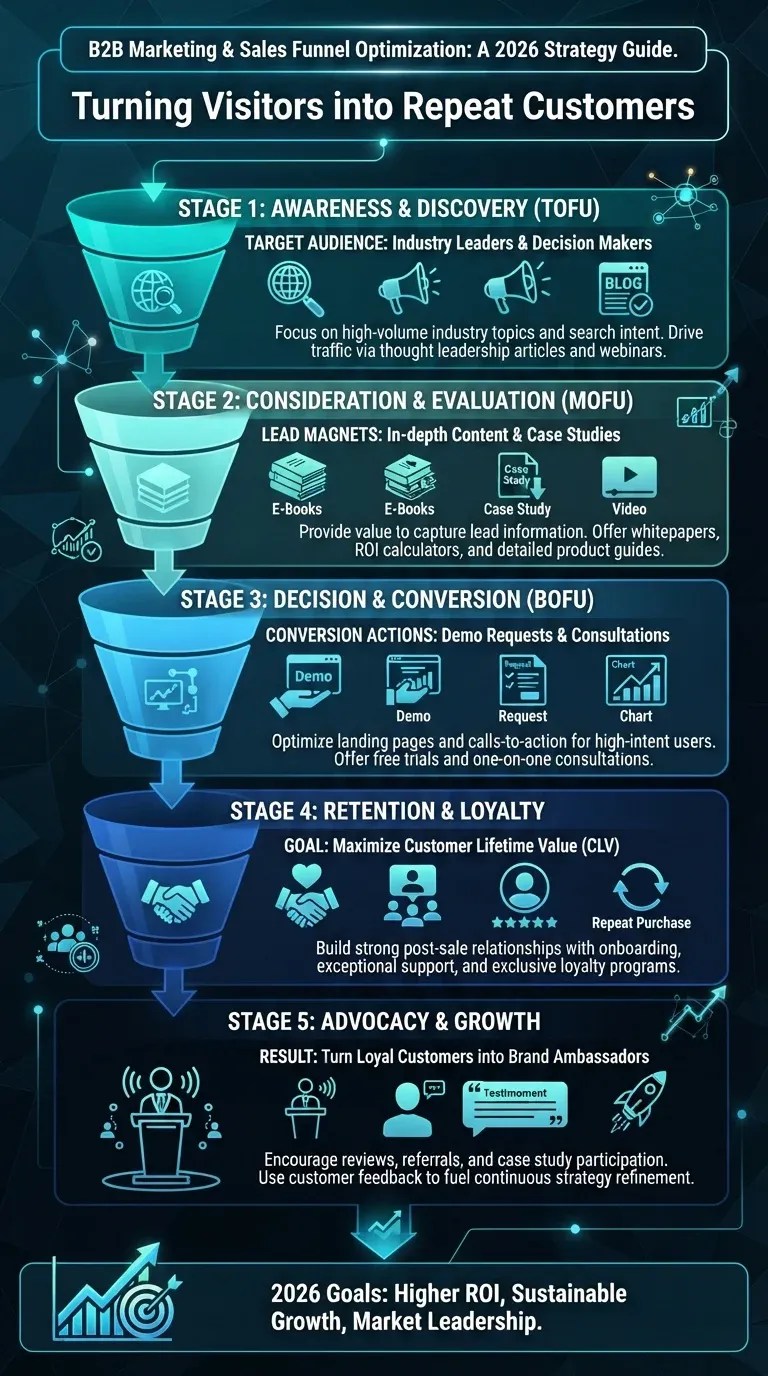
The B2B content funnel is longer and more content-intensive than its B2C equivalent. A buyer moving from initial problem awareness to vendor selection needs different content at each stage — and a gap anywhere in that funnel is a place where the journey stalls and a competitor steps in.
Top of Funnel: Problem Awareness Content
At the top of the funnel, the buyer knows they have a problem but hasn’t yet framed it in terms of solution categories. The content that serves them here is diagnostic and educational: explaining the problem clearly, quantifying its impact, and helping them understand what’s causing it. This is where thought leadership and pain-point-first SEO content live — the pieces that rank for problem searches and introduce the brand as a credible source before the buyer is anywhere near evaluating vendors.
Middle of Funnel: Solution Evaluation Content
Once a buyer has framed their problem and is evaluating solution approaches, the content that serves them shifts toward comparison, criteria-setting, and decision support. “How to evaluate [category] vendors,” “what to look for in a [solution type],” and “the difference between approach A and approach B” are all middle-funnel content formats that position your brand as the informed guide helping the buyer make a better decision — regardless of whether they’ve decided on your solution yet.
Bottom of Funnel: Vendor Selection Content
Bottom-of-funnel B2B content addresses the buyer who has decided they need a solution and is now deciding which vendor to choose. Case studies, detailed service pages, ROI calculators, and comparison pages (“us vs competitor”) all live here. This content typically carries lower search volume than top-of-funnel pieces but converts at far higher rates — these are buyers who know what they need and are conducting final due diligence.
Thought Leadership as a B2B SEO Multiplier
Thought leadership is the B2B SEO asset that compounds most powerfully over time — and the one most businesses treat as a vague aspiration rather than a concrete content strategy. Done with real specificity and genuine expertise, thought leadership content earns backlinks naturally, gets shared across professional networks, and builds the kind of domain authority that makes every other piece of content on the site perform better.
What Thought Leadership Actually Means in Practice?
Thought leadership isn’t just opinion content with the author’s headshot on it. It’s content that advances the conversation in the category — original research, contrarian but defensible positions, frameworks that help practitioners think about problems more clearly, or detailed analysis of industry trends backed by data. The bar is genuinely high, which is exactly why it earns disproportionate authority when it clears it: most B2B content doesn’t try to move the needle, it just restates conventional wisdom.
LinkedIn SEO and Amplification
LinkedIn SEO — optimizing both company pages and individual executive profiles to surface in platform search and feed algorithms — complements website SEO in B2B specifically because it’s where B2B buyers spend professional attention. A thought leadership piece published on the website that’s also distributed through an executive’s LinkedIn presence reaches the same audience through two different channels, reinforcing the brand’s authority from multiple directions simultaneously.
Technical SEO Considerations Specific to B2B Sites
B2B sites have technical characteristics that create specific SEO considerations consumer sites don’t face — gated content, complex product or service architectures, long-form technical documentation, and sometimes significant indexation challenges from CMS configurations built for enterprise content management rather than search performance.
Handling Gated Content Without Sacrificing SEO
Many B2B businesses gate their most valuable content behind lead forms — a reasonable demand generation tactic that creates a real SEO tension. Content that can’t be crawled can’t rank. The most effective resolution is a hybrid approach: a substantive, ungated overview that provides genuine value and ranks in search, with the deeper resource (the full report, the detailed guide, the interactive tool) behind the form. This surfaces the content in search results while preserving the lead capture mechanism.
Structured Data for B2B Content Types
B2B sites frequently publish content types — FAQs, how-tos, events, products, people profiles — that benefit from structured data markup but often go unmarked. Implementing schema correctly for these content types improves search result presentation (rich snippets, knowledge panels, FAQ expansions) and signals content structure to crawlers more clearly, both of which have meaningful impact on click-through rates from organic results.
Converting B2B Organic Traffic Into Pipeline
The conversion path from organic search visit to qualified pipeline is longer and more multi-touch in B2B than in B2C, which means attribution is harder and the temptation to undervalue SEO’s contribution is real. Understanding how organic traffic actually converts in a B2B context is essential for defending the investment and optimizing the conversion path.
Micro-Conversions as Pipeline Signals
Most B2B organic visitors aren’t ready to request a demo or fill out a contact form on their first visit — or their second, or their third. Tracking micro-conversions — content downloads, webinar registrations, newsletter signups, return visit frequency — gives a more complete picture of how organic traffic is moving through the funnel even before it converts in the traditional sense. A visitor who downloaded a white paper, returned twice in the following month, and then requested a demo six weeks later is an SEO conversion; first-click attribution just doesn’t see it.
Case Study: Using B2B SEO to Reduce Customer Acquisition Cost
A B2B SaaS company in the compliance software space was generating most of its pipeline through paid search — effective but expensive, at a customer acquisition cost that made certain customer segments unprofitable. The organic strategy at the time was minimal: a handful of product-focused pages and a blog that published sporadically without a keyword strategy.
Over twelve months, we rebuilt the organic strategy from the ground up: a comprehensive b2b keyword research exercise mapping pain-point keywords, solution keywords, and competitor comparison keywords to a content architecture organized by buyer persona and funnel stage. Thought leadership content targeting industry-specific compliance challenges was developed for top-of-funnel, supported by detailed solution content and case studies at the middle and bottom.
By month twelve, organic traffic had grown substantially, and — more critically for the business case — the cost per pipeline opportunity from organic was approximately 60% lower than the equivalent cost from paid search. The paid budget wasn’t eliminated; it was reallocated toward higher-intent terms where paid placement still made sense, while organic covered the broader funnel. That reallocation improved overall blended CAC meaningfully across the business.
Building a B2B SEO Strategy That Matches How Your Buyers Actually Buy
Lead generation SEO in B2B isn’t about ranking for everything — it’s about owning the specific searches your specific buyers run at each stage of a buying journey that might span months. The businesses that do this well don’t just generate traffic; they build a content asset base that keeps working across every deal cycle, compounds in authority over time, and reduces dependence on paid channels that reset to zero the moment the budget pauses.
That’s the structural advantage of B2B SEO done right: it builds an owned distribution channel that belongs to the business permanently, not a rented one that belongs to whoever’s running the ad auction.
Want a B2B SEO strategy built around how your buyers actually research and decide? Talk to our B2B SEO team and get a strategy mapped to your specific sales cycle, buyer personas, and competitive landscape.
Frequently Asked Questions
B2B SEO targets longer buying cycles, multiple decision makers, and lower-volume but higher-intent keywords. Unlike B2C, where a single buyer might convert in hours, B2B strategy must serve buyers across months of research across multiple stakeholders — each with their own search behavior and content needs.
Start with keyword research that maps pain points and decision-maker language rather than product features, build content for each stage of the B2B funnel, develop genuine thought leadership that earns authority and backlinks, ensure technical health particularly around gated content, and track micro-conversions that reflect pipeline movement rather than just contact form submissions.
Pain-point-first educational content at the top of funnel, comparison and evaluation guides in the middle, and case studies and detailed service pages at the bottom. Original research and thought leadership content earns disproportionate backlinks and authority relative to the investment, particularly in specialized B2B categories.
Meaningful organic traffic movement typically begins within three to six months for lower-competition terms, with the compounding benefits of authority and thought leadership becoming significant in the six to twelve month window. Given B2B’s already-long sales cycles, an SEO program that starts generating qualified organic traffic at month six and converts that traffic to pipeline at month nine is delivering within a competitive timeframe relative to most paid alternatives.
Account-based marketing and B2B SEO complement each other well. SEO generates broad awareness and inbound pipeline from buyers who find you through search; ABM targets specific high-value accounts with personalized outreach. Companies running both often use intent data — one of the signals that informs ABM targeting — to identify companies already engaging with their SEO content, creating a warm ABM touchpoint from an audience that’s already in the research phase.
Discover more from Web Pivots®
Subscribe to get the latest posts sent to your email.


You must be logged in to post a comment.