


Most companies go international the same way. They pick markets from the sales team’s wish list, run the website through a translation plugin and wait for the leads. A year later, a few countries perform, most do not, and nobody can explain the difference.
A working international SEO strategy reverses that order. You choose markets from evidence, research how each one actually searches, set up a URL structure and hreflang that Google can read, localize keywords, offers and proof for each audience, and measure every country separately. Translation comes last, not first.
This framework comes from practice. We recently researched ten markets for our own agency, from Nigeria and Egypt to Germany, the UAE and the USA, and the findings shaped every step below. You will see real examples of where assumptions broke down, and a 90-day roadmap you can adapt for your own international SEO programme.
Why an International SEO Strategy Fails When It Starts With Translation?
Translation answers the wrong question. It asks, “How do we say our English page in another language?” The right question is, “What do buyers in this market search for, and what would convince them?” Those two questions lead to different pages.
Search intent does not travel
In our own research, a common Arabic phrase meaning “e-marketing company in Egypt” returned mostly job listings rather than agencies, and Arabic searches for digital marketing agencies in Dubai surfaced guides to starting an agency. A literal translation of an English keyword list would have targeted searches that never convert. The same problem appears in English: searches for “digital marketing agency Lebanon” returned agencies in Lebanon, Pennsylvania and Lebanon, Tennessee.
Plugins can quietly block indexing
Translation plugins are useful, but their defaults are not always SEO-safe. We have seen multilingual sites where every translated page carried a canonical tag pointing back to the English original. That tells Google the translations are duplicates, so they rarely appear in search at all, however good the content.
Quality signals differ by market
Machine translation that looks acceptable in one language can be embarrassing in another. On one German page we reviewed, “lead growth” had become a word meaning growth in leadership. German B2B buyers notice that immediately, and so do the AI systems and quality raters that judge whether a page is genuinely helpful. A global SEO strategy has to budget for native review from the start.
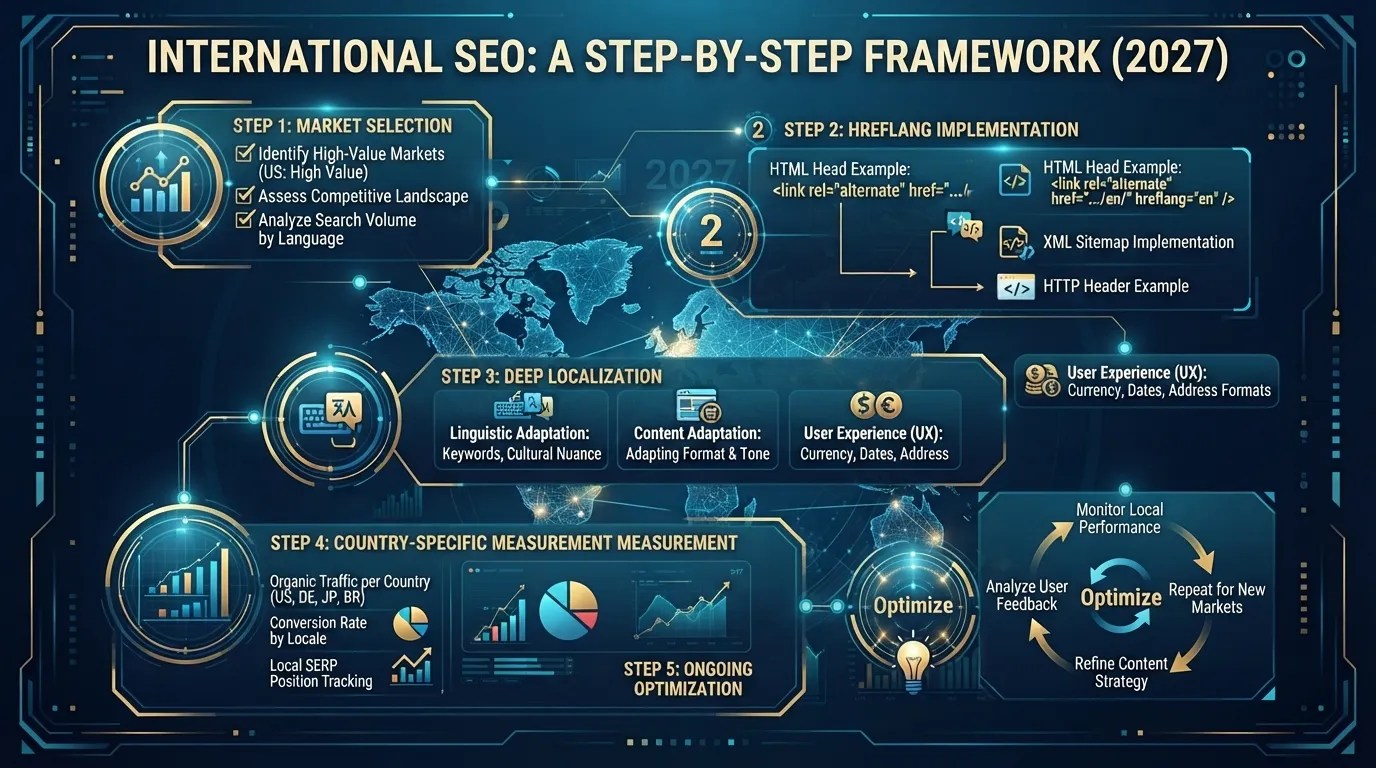
The Five-Stage International SEO Strategy Framework
The framework below is the sequence we use. Each stage feeds the next, and the last one sends you back to the first with better data.
[embed: node/d2bc3d11-7d68]
Notice where localization sits. It is the fourth step, after you know which markets deserve investment, what people there actually search for, and how your site will serve each language or country. Skipping ahead to translation is the most expensive shortcut in multi-country SEO: it produces pages before anyone has checked whether they can be indexed or whether anyone searches for them.
Choosing Markets With Evidence, Not Intuition
Market selection decides most of your return before any page is written. When we compared ten markets for our own international SEO strategy, the differences were far larger than we expected. Monthly SEO budgets ranged from roughly ₦100,000 to ₦500,000 in Nigeria to €1,500 to €5,000 in Germany for comparable SME work. Competition ranged from directory-dominated results in some markets to decades-old domestic agencies in others.
A simple scoring model
We scored every market and topic on six factors, weighted to reflect what drives revenue rather than traffic.
| Factor | Weight | What it asks |
|---|---|---|
| Business relevance | 20% | Do we sell something this market needs? |
| Commercial intent | 20% | Do searches here signal buying, not browsing? |
| Demand evidence | 15% | Is there observed search demand, not just a hunch? |
| Competitive feasibility | 15% | Can we realistically rank against current results? |
| Gap strength | 15% | Are existing results weak, thin or outdated? |
| Proof availability | 15% | Do we have local case studies, language skills or references? |
The last factor matters more than it looks. A smaller market where you have local case studies or native-speaking staff can outscore a larger one where you have neither, because proof is what turns rankings into enquiries.
Look at who actually ranks
Before committing, search your core commercial terms in each market and note what kind of page ranks. In several of the markets we studied, directories and “best agencies” listicles occupied most commercial results. That changes the plan: you may need directory profiles and genuine reviews alongside your own pages, not instead of them.
URL Architecture and Hreflang Decisions
Once you know your markets, decide how your site will serve them. Google’s guidance on managing multi-regional and multilingual sites is the reference point, and three points from it shape most decisions.
First, Google needs explicit signals. It explains that its crawlers do not vary their origin to discover locale versions of a page, so you must declare them through hreflang, country-code domains or clear links. Second, it ignores locational meta tags such as geo.position, so those old shortcuts do nothing. Third, when similar content exists in the same language on several URLs, such as German pages on both a .de domain and a /de/ folder, you should pick a preferred version and use canonical and hreflang tags together.
Choosing a structure
Most companies choose between subfolders (example.com/de/), country-code domains (example.de) and subdomains (de.example.com). Google lists clear geotargeting as a strength of country-code domains, alongside higher cost and the fact that each one targets a single country. Subfolders usually suit companies starting out, because they inherit the main domain’s authority and keep maintenance in one place. Our guide to international site structure compares the options in detail.
Hreflang rules that prevent most problems
Whichever structure you choose, every language or country version should carry a self-referencing canonical, list all its alternates (including itself) in hreflang, and be linked back from each alternate. Add an x-default for users who match none of your versions. Then verify in Search Console’s URL Inspection that Google has selected each page as its own canonical. That single check catches the plugin problem described earlier.
Localizing Keywords, Offers and Proof per Market
Localization is where an international SEO strategy earns or loses trust. It covers three layers, and most companies only do the first.
Keywords: research, don’t translate
Start each market with native-speaker keyword research in the local language and in English, then check the live search results for intent. Expect surprises: dialects, compound words, English loanwords and transliterated terms all change what people type. In Arabic markets, for example, buyers may search in Modern Standard Arabic, in dialect or in Latin script, and each produces different results.
Offers: price, currency and terms
Searchers in different markets ask different commercial questions. In our research, pricing queries were among the most consistent opportunities across markets, but the useful answer differed each time: naira and dollar ranges in Nigeria, dirhams before VAT in the UAE, hourly euro rates in Germany. Local currency, payment methods, delivery or service terms and contract norms belong on localized pages, not hidden in a PDF.
Proof: what convinces this buyer?
Trust signals vary too. German buyers expect a complete legal notice and precise specifications. Gulf buyers often weigh local presence and Arabic-language support. Nigerian and Egyptian buyers frequently start conversations on WhatsApp. Show the case studies, references and contact options that matter in each market, and never invent local proof you do not have. If you lack local references, say so plainly and lead with relevant international results instead.
Measuring International SEO Performance by Country
A blended global report hides almost everything that matters. One strong market can mask three that are failing, so measure each country and language on its own.
The metrics that matter
Track each market through a short chain of indicators, from technical health to revenue. Indexed pages per language version tell you the setup works. Impressions and clicks per country in Search Console, filtered by page folder or domain, tell you whether demand is being captured. Qualified enquiries and revenue by country, taken from your CRM rather than analytics alone, tell you whether it is worth continuing.
Watch for cross-market cannibalization
When several English versions exist, for example for the UK, USA and Canada, check which URL Google shows in each country. If the US page keeps appearing in UK results, your hreflang or content differentiation needs work.
Account for consent and messaging gaps
Analytics undercounts in markets where many users decline cookies, and in markets where enquiries arrive through WhatsApp or phone rather than forms. Pair analytics with Search Console data and CRM records so you do not cut a market that is actually performing.
Review every market quarterly and reallocate. Markets that show rising impressions but few enquiries usually need better localization and proof; markets with flat impressions after six months may need different keywords or less investment.
A 90-Day International SEO Strategy Roadmap
You do not need to launch ten markets at once. The first 90 days should prove the process in one or two markets, then expand.
Days 1–30: evidence and foundations
Score your candidate markets and pick one or two. Run native keyword research for each and check live results for intent. Audit your site’s technical setup: language versions, canonicals, hreflang and sitemaps. Fix anything that would stop new pages from being indexed before you write a word.
Days 31–60: core localized pages
Localize your highest-value pages first, usually the homepage, main service or category pages and one pricing or comparison page per market. Write or edit them natively. Add local proof, currency and contact options, and set up country-level reporting in Search Console and your CRM.
Days 61–90: content, authority and review
Publish two or three supporting articles per market that answer local commercial questions. Start earning local links and listings: relevant directories, associations and partner sites. At day 90, review indexation, impressions and first enquiries per market, then decide whether to deepen, adjust or expand.
For a detailed market-specific example, see our guide to SEO in Germany, which applies this approach to a single market over twelve months.
Frequently Asked Questions About International SEO Strategy
It is a plan for earning organic visibility in more than one country or language. It covers which markets to target, how your site serves each one technically, how content is localized, and how performance is measured per market.
Neither is better in every case. Subfolders usually suit companies starting out because they inherit the main domain’s authority. Country-code domains give the clearest geotargeting signal but cost more and start with little authority.
Only if you target several countries with similar content in that language, such as separate UK, US and Canadian English pages. If you have one English version for everyone, hreflang is not required.
As a first draft, sometimes. Every page you want to rank should be reviewed or rewritten by a native speaker, and keywords should be researched in each language rather than translated.
Technical fixes can show indexation gains within weeks. Rankings and enquiries in a new market typically take six to twelve months, depending on competition and how much local authority you build.
Build Your International SEO Strategy on Evidence
An international SEO strategy that works is less about technology and more about sequence. Choose markets on evidence, research each one natively, give Google clear signals through structure and hreflang, localize the things buyers actually judge you on, and measure every country on its own. Repeat the cycle every quarter. Companies that follow that order spend less on content that never ranks, and more on markets that return enquiries.
Web Pivots plans and runs international SEO across the Middle East, Africa, Europe and North America, with native German speakers on the team. If you are expanding, or your existing country pages are underperforming, request a free growth audit of your international SEO strategy and technical setup.
Discover more from Web Pivots®
Subscribe to get the latest posts sent to your email.


You must be logged in to post a comment.