


The appeal of automated email campaigns isn’t just efficiency — it’s the specific satisfaction of waking up to revenue that arrived while you were asleep. A well-built email automation system doesn’t require daily attention to keep working; it runs on behavioral triggers, pre-written sequences, and timing logic you set up once and iterate on over time. For businesses that have built even a modest email list, automation is consistently one of the highest-return investments available — not because email is magic, but because it reaches people at exactly the moment they’ve already expressed interest, with exactly the message that fits where they are in the buying process.
What follows is a practical playbook for ten automation sequences every business should have running. For each one: what it does, how many emails it should contain, when each sends, and example subject lines worth modeling from. Not theory — actual frameworks you can build this week.
Why Automated Email Campaigns Outperform Broadcast Newsletters
Broadcast emails — the “send to everyone” approach — have their place, but they’re inherently generic. The same message goes to a brand-new subscriber and a customer who’s bought three times, despite the fact that those two people need completely different communication. Email drip sequences triggered by specific behavior solve this: the message a subscriber receives is determined by what they did, not just when you happened to send something.
Behavioral Triggers Are the Key Difference
A behavioral trigger is an action — or inaction — that kicks off a sequence automatically. A new subscriber triggers a welcome series. A purchase triggers a post-purchase flow. Thirty days of silence triggers a re-engagement sequence. Each trigger ensures the message matches the moment, which is the core reason automated sequences consistently outperform broadcast emails on both open rate and click-through rate.
Sequence 1: The Welcome Series
The welcome series is the most important automation in any business’s stack, and the one most commonly done poorly — or skipped entirely. The moment someone subscribes is the peak of their interest; letting that moment pass with silence, or wasting it on an immediate sales pitch, sacrifices the most valuable window in the subscriber relationship.
Purpose, Timing, and Structure
Purpose: Establish trust, set expectations, and introduce the brand before asking for anything. Emails: 3–5. Timing: Email 1 immediately on signup, Email 2 at day 2, Email 3 at day 4, Emails 4–5 at days 7 and 10 if included.
Example subject lines: “Welcome — here’s what to expect from us” / “The one thing most [your niche] get wrong (and how we fix it)” / “We’d love to know one thing about you”
Sequence 2: Lead Magnet Delivery
When someone opts in specifically for a free resource — a checklist, template, guide, or mini-course — the delivery email needs to do more than attach the file. It’s the first real interaction, and how it’s handled sets the tone for everything that follows.
Purpose, Timing, and Structure
Purpose: Deliver the promised resource immediately, then use the follow-up window to reinforce the value and bridge toward the next step. Emails: 3. Timing: Email 1 immediately on signup, Email 2 at day 2 (“did you get a chance to use it?”), Email 3 at day 4 (deeper value add or relevant next step).
Example subject lines: “Your [resource name] is ready — download here” / “Quick question about the [resource]” / “One more thing that goes with the [resource]”
Sequence 3: The Nurture Drip
The nurture sequence is the long game — a series of value-first emails designed to build authority and trust with subscribers who aren’t ready to buy yet. Most leads need multiple touchpoints before they convert; a nurture drip provides those touchpoints without requiring manual effort.
Purpose, Timing, and Structure
Purpose: Educate, build credibility, and keep the brand top of mind until the subscriber is ready to act. Emails: 5–8, spaced over 3–6 weeks. Timing: Every 4–7 days after the welcome series ends, rotating between educational content, case studies, and soft CTAs.
Example subject lines: “The [industry] mistake that’s costing you [outcome]” / “How [client type] went from [problem] to [result]” / “Honest question: what’s holding you back?”
Sequence 4: The Sales Sequence
When a subscriber has been nurtured and shows signals of commercial intent — clicking a pricing page, visiting a service page multiple times, or reaching the end of a nurture drip — a focused sales sequence gives them the specific information and social proof needed to make a decision.
Purpose, Timing, and Structure
Purpose: Convert a warm, educated lead into a customer by addressing remaining objections and making the offer clear. Emails: 4–6. Timing: Triggered by a commercial intent signal, sent every 2–3 days over 10–14 days. Final email should create genuine urgency — a deadline, a bonus that expires, or a limited availability notice.
Example subject lines: “Here’s exactly what working with us looks like” / “Three questions people ask before they sign up” / “Last chance: [offer or bonus] expires tonight”
Sequence 5: Abandoned Cart Recovery
The abandoned cart sequence is the closest thing to a guaranteed ROI in ecommerce email automation. Someone added a product to their cart — they were interested enough to get that far — and then left. A well-timed, well-written recovery sequence converts a meaningful portion of those near-misses into completed purchases.
Purpose, Timing, and Structure
Purpose: Recover the lost sale by reminding, then reassuring, then creating urgency. Emails: 3. Timing: Email 1 at 1 hour after abandonment (the reminder), Email 2 at 24 hours (address the objection — often shipping cost, return policy, or trust), Email 3 at 48–72 hours (urgency: low stock, expiring offer, or small discount).
Example subject lines: “You left something behind” / “Still thinking it over? Here’s what you should know” / “Your cart expires soon — plus 10% off to finish up”
Sequence 6: Post-Purchase Flow
Most businesses treat the sale as the finish line. Smart operators treat it as the starting line of the customer relationship. The post-purchase flow sets expectations, reduces buyer’s remorse, and begins building the loyalty that drives repeat purchases — all while the customer’s enthusiasm for their decision is at its highest.
Purpose, Timing, and Structure
Purpose: Confirm the purchase, set delivery expectations, provide setup guidance, and prime the customer for their next interaction with the brand. Emails: 3–4. Timing: Email 1 immediately (order confirmation + what to expect), Email 2 at day 3 (tips for getting the most from the product/service), Email 3 at day 7 (check-in + introduce loyalty program or related products).
Example subject lines: “Your order is confirmed — here’s what happens next” / “Getting the most out of ” / “How’s everything going so far?”
Sequence 7: Upsell and Cross-Sell Flow
The period immediately following a purchase is the highest-intent moment in the customer lifecycle. The upsell/cross-sell sequence capitalizes on that momentum by introducing complementary products or higher-tier options while the customer is engaged, satisfied, and predisposed to trust the brand.
Purpose, Timing, and Structure
Purpose: Increase average order value and lifetime customer value by introducing relevant adjacent products or upgrades. Emails: 2–3. Timing: Begin 7–10 days after purchase (once the initial product experience has had time to register), spaced 3–5 days apart.
Example subject lines: “Customers who bought also love this” / “The next step most [customer type] take after ” / “Ready to take it further?”
Sequence 8: Review Request
Social proof is one of the most powerful conversion drivers available, and automated review requests are the most reliable way to generate it at scale. The key is timing: ask too soon and the customer hasn’t had enough experience to review honestly; ask too late and the moment of enthusiasm has passed.
Purpose, Timing, and Structure
Purpose: Collect genuine reviews that build trust for future customers. Emails: 2. Timing: Email 1 at 10–14 days post-purchase (enough time for the product/service to be experienced), Email 2 at day 21 if no review submitted (gentler second ask).
Example subject lines: “Quick question about your experience” / “Would you mind sharing your thoughts?” / “Two minutes that would mean a lot to us”
Sequence 9: Re-Engagement Campaign
Every email list accumulates inactive subscribers over time — people who signed up, engaged initially, and then went quiet. A re-engagement sequence attempts to win back their attention before they become a deliverability problem. Inactive subscribers hurt sender reputation; either re-engaging them or removing them cleanly is better than continuing to mail them hoping for the best.
Purpose, Timing, and Structure
Purpose: Identify and re-activate subscribers who have been inactive for 60–90 days, and cleanly remove those who don’t respond. Emails: 3. Timing: Triggered after 60–90 days of no opens or clicks, sent every 5–7 days. Final email should make the “stay or go” choice explicit — this clarity often produces the highest re-engagement rate of the sequence.
Example subject lines: “We’ve missed you — still interested?” / “Is this still useful to you?” / “Should we part ways? (Be honest)”
Sequence 10: Win-Back Campaign
The win-back sequence targets lapsed customers specifically — people who purchased once (or more) but haven’t bought again in a defined window. It’s distinct from the re-engagement sequence, which targets inactive subscribers regardless of purchase history. A lapsed customer already knows and trusted the brand; win-back is about removing whatever barrier stopped them from returning.
Purpose, Timing, and Structure
Purpose: Reactivate customers who haven’t purchased in 90–180 days with a compelling reason to return. Emails: 3–4. Timing: Triggered at the 90-day post-purchase mark, sent every 7 days. Include a genuine incentive — a discount, exclusive access, or personalized product recommendation — in at least one email.
Example subject lines: “It’s been a while — here’s what’s new” / “We saved something for you” / “Come back: [X]% off your next order, just for you”
Putting All Ten Sequences Into a Cohesive Email Funnel
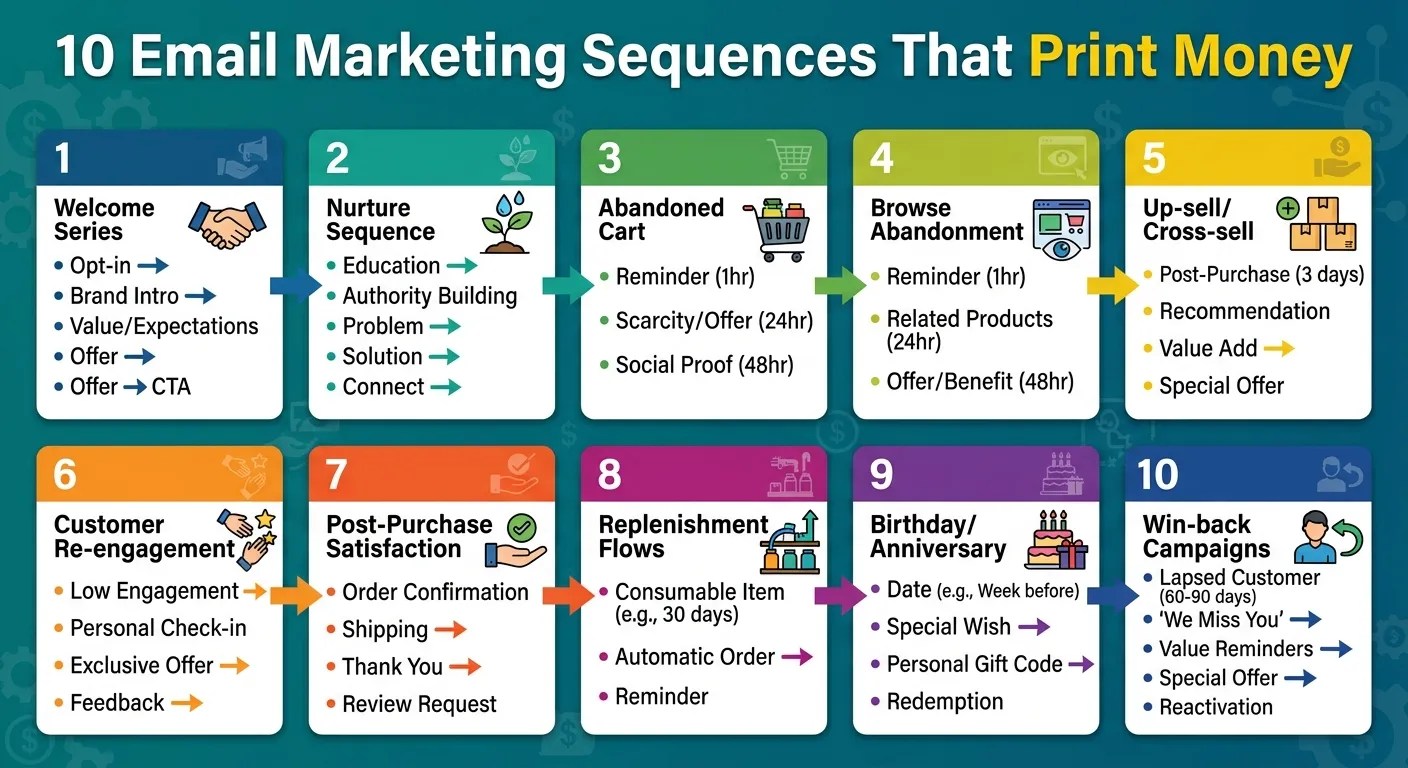
These sequences don’t operate in isolation — they form a connected email funnel that maps to the full customer lifecycle. The welcome series and lead magnet delivery cover acquisition. The nurture drip and sales sequence cover consideration and conversion. Post-purchase, upsell, and review request cover onboarding and loyalty. Re-engagement and win-back cover retention and recovery.
The businesses generating consistent revenue from marketing automation aren’t running all ten perfectly on day one — they’re running one or two well, measuring what the data shows, and adding sequences as the list and customer base grow. Start with the welcome series and abandoned cart if you’re in ecommerce, or the welcome series and nurture drip if you’re in services. Get those right first. The compounding effect of even two well-optimized sequences running continuously is more valuable than ten half-built ones.
Ready to build sequences that actually run while you sleep? Talk to our email automation team and get a custom sequence strategy mapped to your specific funnel.
Frequently Asked Questions
Start with a welcome series and either an abandoned cart sequence (ecommerce) or a nurture drip (services). These two alone consistently deliver the highest return relative to setup effort, and mastering them builds the foundation for the full ten-sequence stack.
Most email platforms — Klaviyo, Mailchimp, ActiveCampaign — include automation builders that let you create trigger-based sequences visually. Start by defining the trigger (new subscriber, purchase, cart abandonment), map the email sequence and timing, write the emails, and test the flow with a real email address before activating.
It depends on the sequence’s purpose. Welcome series work well at 3–5 emails. Nurture drips benefit from 5–8 over several weeks. Abandoned cart and win-back sequences perform best as 3-email flows. The right length is whatever it takes to deliver the sequence’s specific purpose without overstaying the welcome.
A behavioral trigger is a specific action — or period of inaction — that automatically starts an email sequence. Common triggers include subscribing, making a purchase, abandoning a cart, clicking a specific link, or going 60 days without opening an email. Trigger-based sequences outperform broadcast emails because the message matches what the subscriber just did.
Subject line quality is the primary open rate lever — specific, curiosity-driven, or benefit-clear subject lines consistently outperform generic ones. Send timing matters too: most sequences perform best sent on weekdays during business hours, though testing for your specific audience always beats general advice. List hygiene — removing chronically inactive subscribers — also improves deliverability and open rates over time.
Discover more from Web Pivots®
Subscribe to get the latest posts sent to your email.


You must be logged in to post a comment.